How Much Does It Actually Cost to Make a Plastic Part in India? (Honest Breakdown)
Published by InjectMould Industries, Bawana, Delhi • Reading time: ~6 minutes
You ask a manufacturer for a quote. They send back a number. You have no idea if it’s fair.
This is one of the most common frustrations for traders, product companies, and OEM buyers who are new to working with plastic manufacturers in India. Unlike buying a finished product off a shelf, custom plastic manufacturing involves multiple cost layers — and most suppliers don’t explain what goes into their pricing.
The result? Buyers either overpay because they can’t negotiate confidently, or they chase the cheapest quote and end up with quality problems that cost even more to fix.
This article breaks down the actual cost of making a plastic part in India — honestly and in plain language. Whether you’re planning your first production run or trying to understand why quotes vary so wildly between manufacturers, this breakdown will give you the clarity you need.
Why Plastic Manufacturing Costs Are So Confusing
The core reason pricing feels opaque is that plastic part manufacturing isn’t a single-step process. It involves raw materials, tooling, machine time, labour, quality checks, finishing, and packaging — each with its own cost structure.
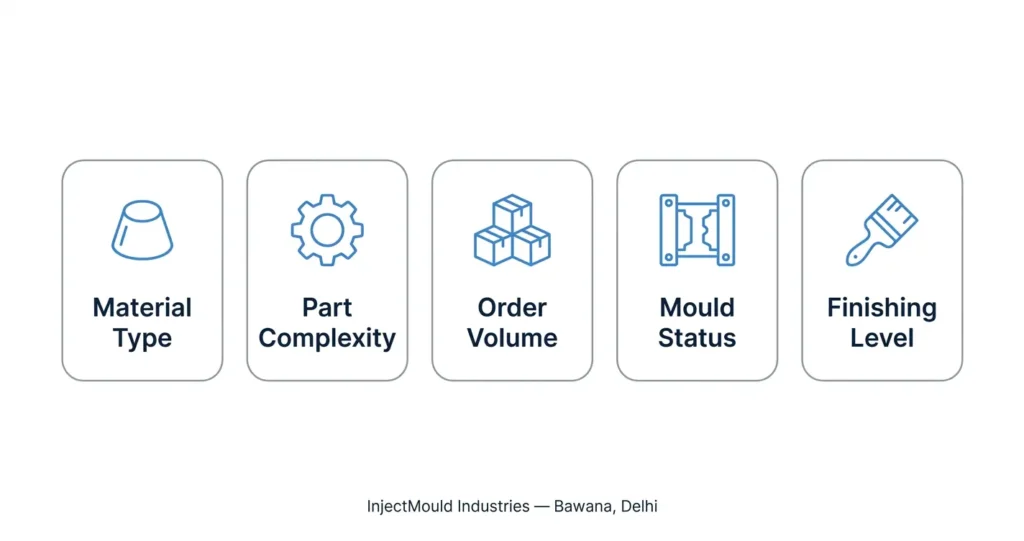
Add to this the fact that costs shift significantly depending on:
- The polymer or plastic material being used
- The complexity and size of the part
- The quantity ordered (volume changes everything)
- Whether you need a new mould or can use an existing one
- The level of finishing, assembly, or post-processing required
Most manufacturers quote a ‘per unit’ price without breaking any of this down. That’s why two quotes for the same part can differ by 40% — and both can be legitimate.
The Real Cost Structure of Making a Plastic Part in India
1. Tooling and Mould Cost (One-Time Investment)
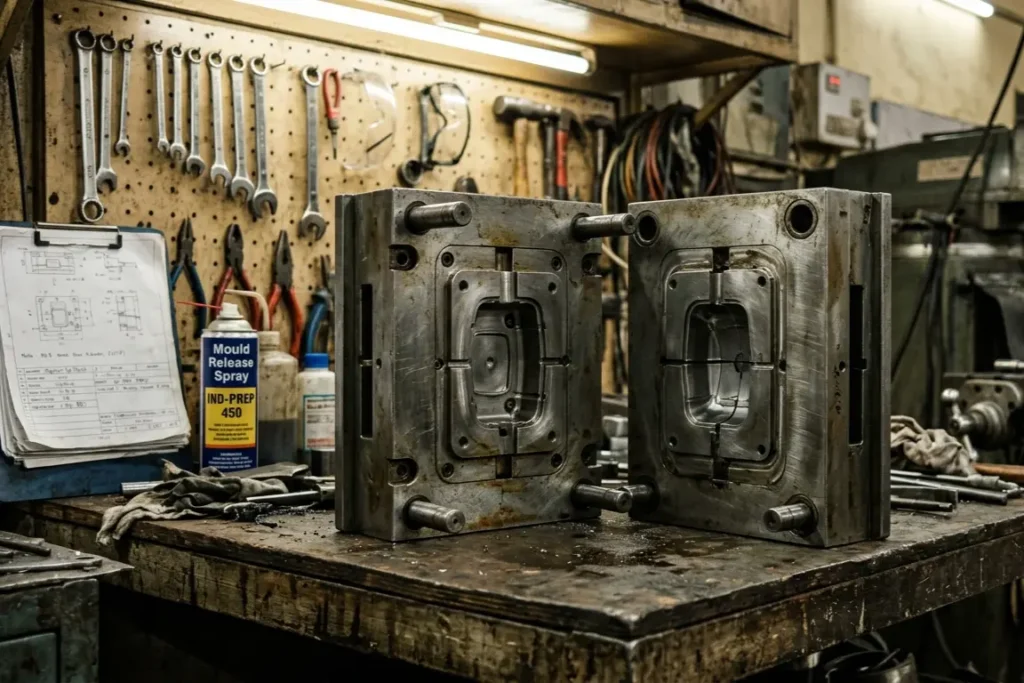
This is the biggest upfront cost for any new plastic part — and the one most buyers underestimate. A mould is the steel or aluminium tool that gives your plastic part its shape. It’s custom-made for every unique product.
In India, mould costs typically range from:
- Simple single-cavity mould: ₹30,000 – ₹80,000
- Medium complexity mould: ₹80,000 – ₹3,00,000
- High complexity or multi-cavity mould: ₹3,00,000 – ₹10,00,000+
The good news: this is a one-time cost. Once the mould is made and approved, it can produce lakhs of units over its lifetime. The more you produce, the lower the mould cost per unit becomes — which is why volume matters so much in plastic manufacturing.
2. Raw Material Cost
The plastic resin or polymer is the primary material cost per unit. Common materials and their approximate market rates in India:
- Polypropylene (PP): ₹90 – ₹110 per kg — most common, food-safe, versatile
- High-Density Polyethylene (HDPE): ₹95 – ₹115 per kg — rigid, chemical resistant
- ABS (Acrylonitrile Butadiene Styrene): ₹130 – ₹160 per kg — durable, used in electronics and automotive
- Nylon (PA6/PA66): ₹150 – ₹200 per kg — high strength, used in gears and industrial parts
- PVC: ₹80 – ₹100 per kg — flexible or rigid, widely used in pipes and fittings
Note: Material prices fluctuate with crude oil prices. Always confirm current rates with your manufacturer before finalising your cost estimate.
3. Machine Time and Production Cost
This is the cost of running the injection moulding machine — electricity, depreciation, operator time, and cycle efficiency. In India, machine rates typically run between ₹300 – ₹2,500 per hour depending on machine size and tonnage.
A simple small part might have a cycle time of 15–30 seconds. A large, complex part could take 60–90 seconds per cycle. This directly determines how many units can be produced per shift and drives your per-unit cost.
4. Labour and Quality Control
Labour in Indian plastic manufacturing is a genuine cost advantage. Skilled machine operators, quality inspectors, and assembly workers typically cost ₹15,000 – ₹30,000 per month — significantly lower than comparable roles in China or Southeast Asia.
For most standard injection moulded parts, labour adds approximately ₹1 – ₹5 per unit to the total cost, depending on how much manual handling or inspection is involved.
5. Finishing, Assembly, and Packaging
Depending on your product, you may need:
- Deflashing or trimming: Removing excess material from parting lines
- Painting, plating, or printing: Adds ₹3 – ₹15 per unit
- Assembly: If multiple plastic parts need to be combined
- Packaging: Basic poly bags add ₹1–₹3 per unit; retail-ready packaging varies widely
Indicative Cost Breakdown by Production Volume
Here’s a realistic range for a simple to moderately complex plastic part manufactured in India:
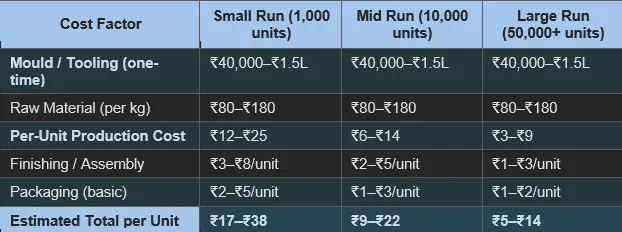
These are indicative ranges — your actual cost will vary based on part weight, material, complexity, and your manufacturer’s overheads. Use this as a benchmarking tool, not a quote.
Hidden Costs Buyers Often Miss
Even experienced buyers sometimes overlook these cost items when comparing quotes:
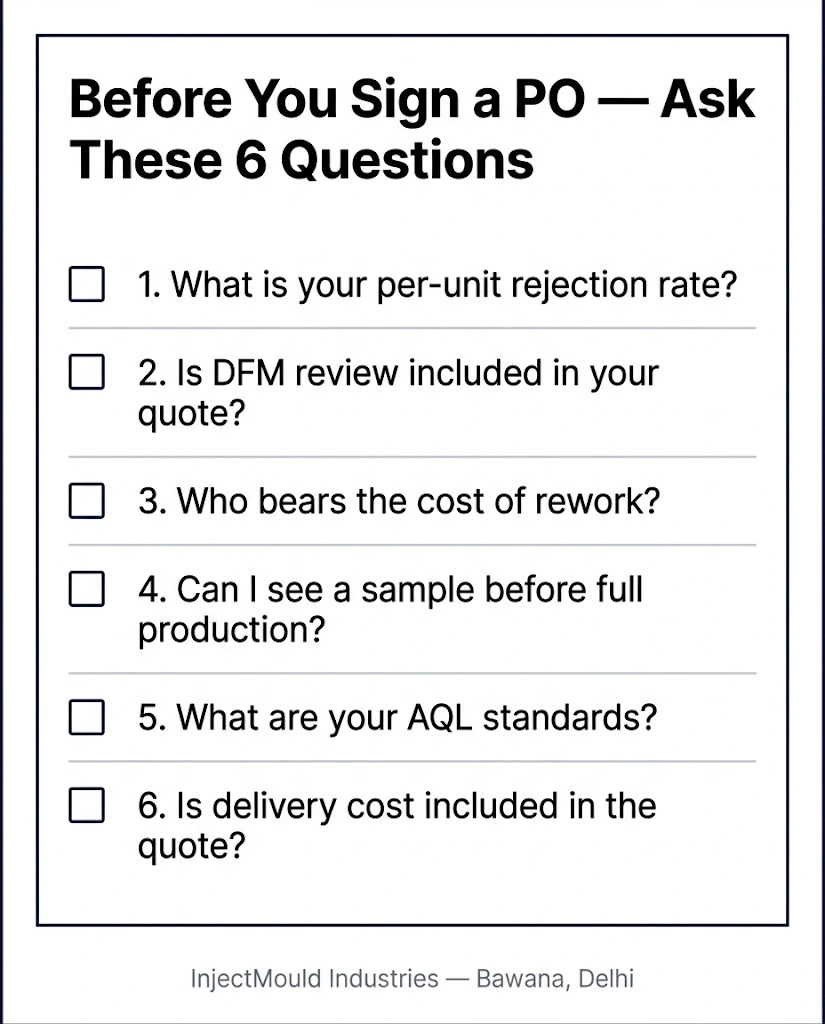
- Mould trials and sampling: Most manufacturers charge ₹3,000 – ₹10,000 for initial sample runs and material trials before full production begins.
- Design for Manufacturability (DFM) revisions: If your part design needs changes to make it mouldable, expect revision costs unless your manufacturer includes DFM review in their service.
- Rejection and rework rate: A manufacturer quoting a very low per-unit price may have a high rejection rate. Always ask about acceptable quality levels (AQL) and who bears the cost of rejected units.
- Logistics and freight: For buyers outside Delhi, delivery cost to your warehouse adds to total landed cost. Factor this in when comparing manufacturers from different locations.
How to Get a Fair Quote from a Plastic Manufacturer
If you go to a manufacturer with just a rough idea or a sketch, you’ll get a rough estimate. If you want an accurate, comparable quote, come prepared with:
- A 2D drawing or 3D CAD file of your part with dimensions
- The material you want (or ask for a recommendation)
- Your target quantity — initial order and expected annual volume
- Any specific tolerance, finish, or colour requirements
- Packaging requirements — bulk, retail-ready, or labelled
The more information you provide upfront, the more accurate — and negotiation-ready — your quote will be.
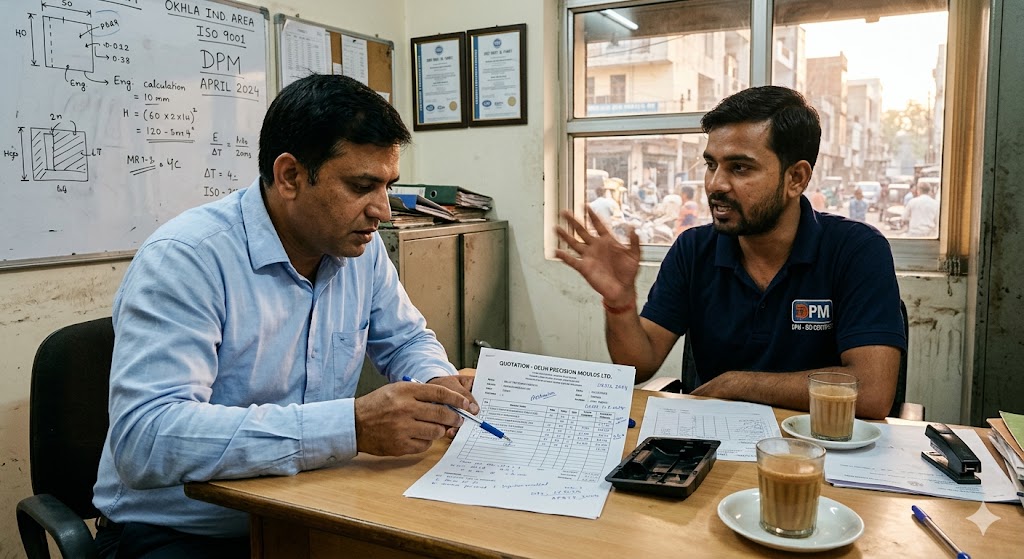
An end-to-end manufacturing partner like InjectMould Industries, based in Bawana, Delhi, will typically walk you through the cost breakdown line by line, so you understand exactly what you’re paying for at each stage. That kind of transparency makes it much easier to plan your pricing and margins confidently.
The Bottom Line
There’s no single answer to ‘how much does it cost to make a plastic part in India’ — but there is a framework. Tooling is the big one-time cost. Material and machine time drive your per-unit cost. Volume is the biggest lever you have to bring that per-unit cost down.
The most important thing is to work with a manufacturer who is willing to explain every line of their quote. Opaque pricing is a red flag — whether it’s unusually low or surprisingly high.
If you’re planning a plastic product run and want a transparent, itemised quote from a Delhi-based end-to-end manufacturer, InjectMould Industries is worth a conversation. From mould design to final packaging, every cost is accounted for — and explained.
— End of Article —
Frequently Asked Questions
The cost depends on your production volume, material choice, and part complexity. For small runs of around 1,000 units, expect ₹17–₹38 per unit. For mid runs of 10,000 units, the range drops to ₹9–₹22 per unit. For large runs of 50,000 units or more, you're typically looking at ₹5–₹14 per unit. Tooling is a separate one-time cost ranging from ₹40,000 to ₹10,00,000 depending on mould complexity — but once the mould is made, it serves the entire production lifetime of that part.
Injection mould tooling in India typically ranges from ₹40,000 for a simple single-cavity mould to ₹10,00,000 or more for high-complexity multi-cavity moulds. The complexity of your part design, the number of cavities required, and the material of the mould itself (steel vs aluminium) are the three biggest factors that move this number. Think of tooling as a one-time capital investment — every unit you produce after that amortises the cost further.
The most widely used materials are Polypropylene (PP) at ₹90–₹110 per kg, HDPE at ₹95–₹115 per kg, ABS at ₹130–₹160 per kg, Nylon at ₹150–₹200 per kg, and PVC at ₹80–₹100 per kg. PP is the go-to for general-purpose parts, ABS for parts that need durability and a premium finish, and Nylon for high-strength industrial applications. Material prices fluctuate with crude oil — always confirm current rates with your manufacturer before locking in your cost estimate.
Come prepared with five things: a 2D drawing or 3D CAD file of your part with dimensions, your preferred material or a request for a recommendation, your initial order quantity and expected annual volume, any specific tolerance, colour, or finish requirements, and your packaging needs. The more detail you give upfront, the more accurate and comparable your quote will be — and the more confidently you can negotiate. Vague briefs produce vague quotes.
InjectMould Industries is an end-to-end plastic manufacturing partner based in Bawana, Delhi, located at Pocket-G, Plot No. 166, DSIIDC Industrial Area, Sector 2, Bawana — 110039. They handle everything from tool and die making and injection moulding to ABS electroplating and assembly, serving OEM, automotive, industrial, and consumer goods sectors across North India. You can reach them at +91 9871398314 or at amandeep@injectmould.in.
Quick Links
- +91 98713 98314
- Home
- About Us
- Contact Us
- Services
Connect With Us
- +91 98713 98314
- amandeep@injectmould.in
- @injectmould.in
About Us
InjectMould Industries is an end-to-end manufacturing partner for OEMs, delivering reliable custom plastic parts and plastic component manufacturing. Located in Bawana , Delhi.
As experienced plastic component manufacturers, we specialize in injection moulding, tool and die making, and plastic die maker services.We also offer ABS plastic electroplating
for high-quality finishes on functional and aesthetic parts.
injection moulding services
Plastic parts manufacturer bawana