
MOQ vs. Cost Per Part: What Every Plastic Trader Must Know Before Placing an Order
Published by InjectMould Industries, Bawana, Delhi • Reading time: ~6 minutes
You get a quote from a manufacturer. The per-unit price looks great. Then you see the MOQ — 25,000 units. Your stomach drops.
This is the moment most plastic traders either overcommit and tie up cash they can’t afford to, or walk away from a deal that could have been structured differently. The relationship between Minimum Order Quantity and cost per part is one of the most misunderstood dynamics in plastic manufacturing — and getting it wrong in either direction costs real money.
Order too few units and your per-part cost kills your margin. Order too many and you’re sitting on stock that takes months to clear, with working capital locked up and warehouse space eaten up. Neither extreme is sustainable for a growing trading business.
This article breaks down exactly how MOQ and cost per part interact, what levers you have as a buyer to negotiate smarter, and how to find the quantity sweet spot that protects both your margin and your cash flow.
What MOQ Actually Means — and What It Doesn't
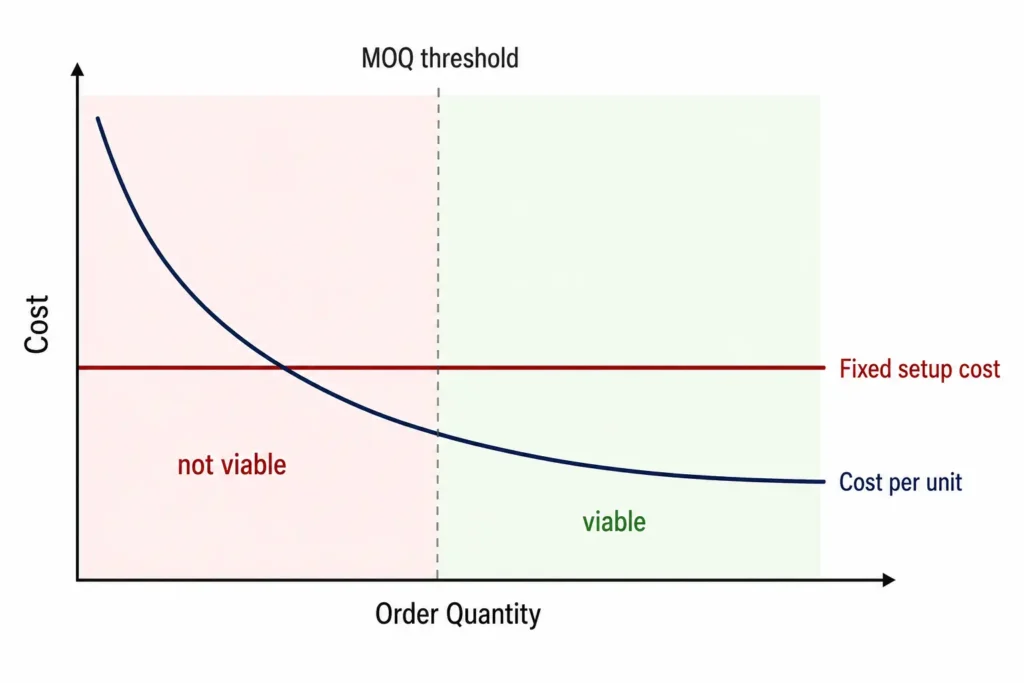
MOQ stands for Minimum Order Quantity — the smallest number of units a manufacturer will produce in a single run. It’s not an arbitrary number. It exists because plastic manufacturing has fixed costs that don’t change regardless of how many units you make.
Every production run involves:
- Setting up and cleaning the injection moulding machine
- Loading and purging the material
- Running trial shots until quality stabilises
- Quality inspection at start and end of run
- Packaging and dispatch preparation
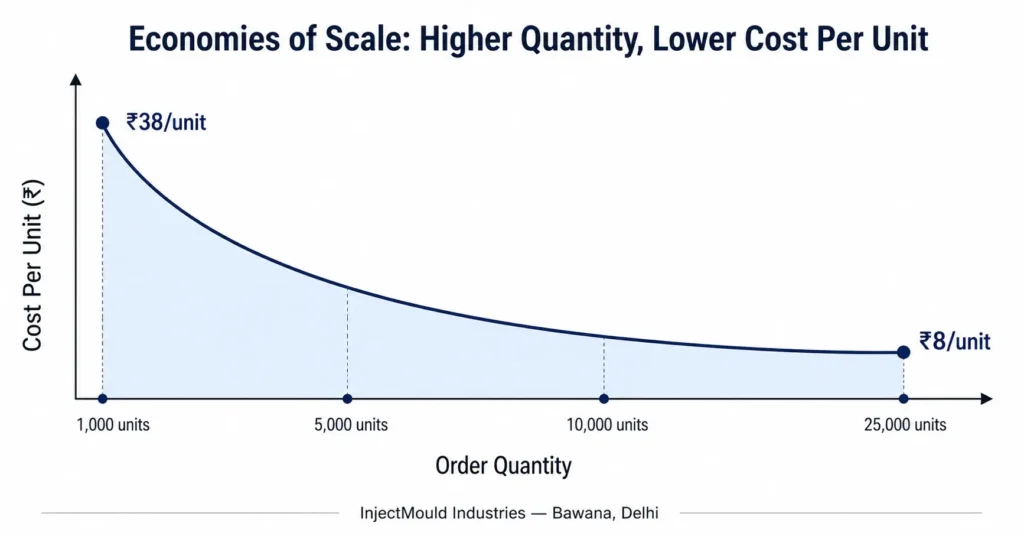
All of this costs the manufacturer roughly the same whether they’re making 500 units or 5,000. The MOQ is their way of ensuring the fixed cost of a production run is spread across enough units to make it economically viable for both sides.
What MOQ doesn’t mean: it’s not always fixed. Many manufacturers — especially smaller, more flexible ones — will negotiate MOQ if you’re willing to absorb a higher per-unit cost or commit to a future order. Understanding this gives you more room than most traders realise.
How MOQ and Cost Per Part Are Directly Connected
The relationship is straightforward but has important nuance. As your order quantity increases, three things happen simultaneously:
- The fixed setup cost gets spread over more units — lowering the per-unit contribution of that cost.
- Material buying power increases — manufacturers often get better raw material rates at higher volumes and pass some of this on.
- Machine efficiency improves — longer uninterrupted runs produce parts faster with less waste.
Here’s what this looks like in practice for a moderately complex plastic part made in India:
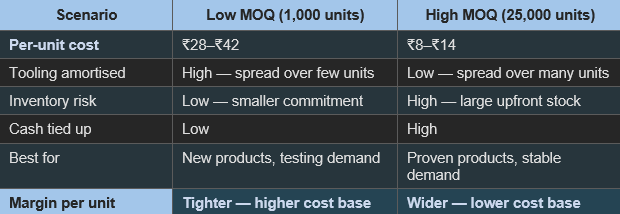
The numbers tell a clear story — but the right column isn’t always the right answer. A lower per-unit cost means nothing if you can’t sell 25,000 units within a reasonable timeframe.
The Hidden Cost of Chasing the Lowest Per-Unit Price
Many traders make the mistake of optimising for cost per part without accounting for what economists call the total cost of ownership. Here’s what that means in practice:
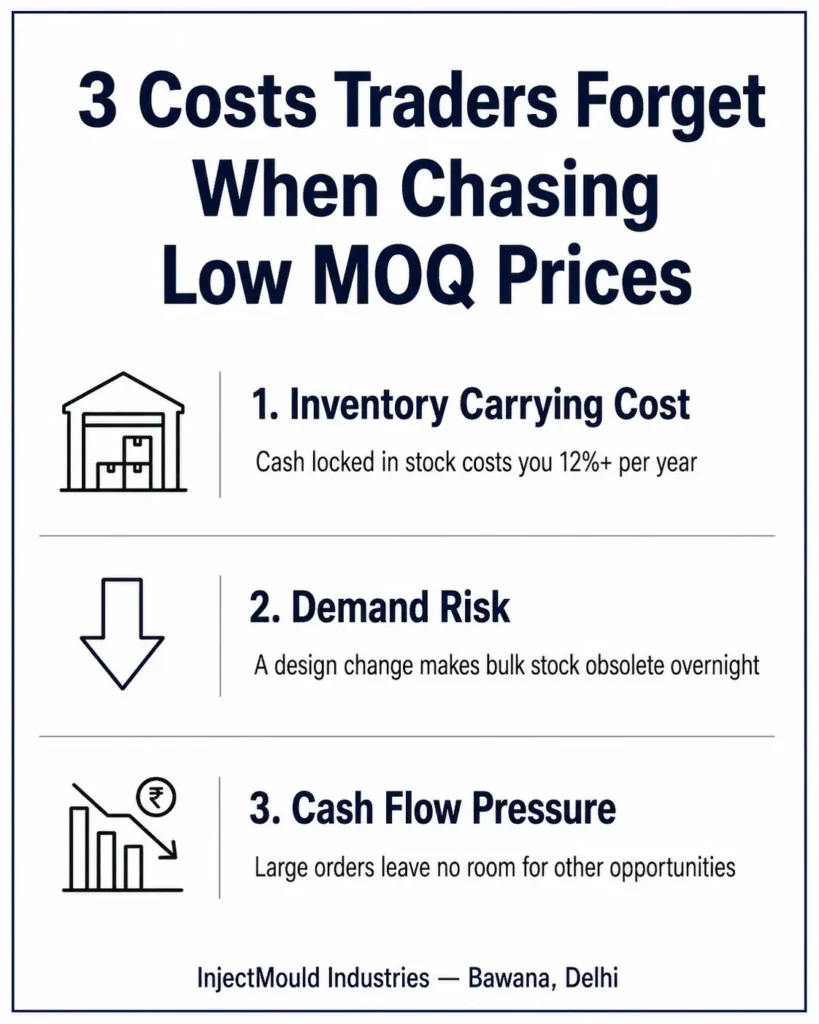
Inventory Carrying Cost
Every unit sitting in your warehouse has a cost — storage, insurance, handling, and most importantly, the opportunity cost of the cash tied up in that stock. For a trader carrying ₹10 lakh worth of plastic inventory at 12% annual interest, that’s ₹1.2 lakh per year just in financing cost, before a single unit is sold.
If you order 25,000 units at ₹10 each to get a great per-unit rate, but it takes you 8 months to sell them, the carrying cost has already eroded a significant portion of your margin advantage over the smaller, more expensive order.
Demand Risk
Plastic products — especially in consumer goods and FMCG — are vulnerable to design changes, seasonal demand shifts, and market preference changes. A large order placed to hit a low MOQ locks you into a specific product version. If your client asks for a colour change or a dimensional tweak three months in, you may be sitting on obsolete stock.
Cash Flow Pressure
Working capital is the lifeblood of a trading business. A large upfront order payment concentrates your risk in a single product and leaves less headroom for other opportunities. Smaller, more frequent orders — even at a higher per-unit cost — often produce better overall business health.
How Smart Traders Negotiate MOQ Without Sacrificing Margin
The goal isn’t always to get the lowest MOQ or the lowest cost per part — it’s to find the quantity that optimises your total economics. Here are the strategies that work:
1. Commit to Annual Volume, Order in Tranches
Instead of placing one large order to hit a low price tier, negotiate a blanket purchase order for the full annual quantity — but take delivery in monthly or quarterly tranches. The manufacturer gets the volume commitment they need to justify a lower price. You get the unit economics without the inventory risk.
This works best when you have a stable, repeat-purchase product with predictable offtake. It requires a manufacturer willing to hold work-in-progress or finished goods inventory between tranches — not all of them will, but many flexible manufacturers will for a committed buyer.
2. Share a Mould Across SKUs
If you have multiple similar products — different colours of the same part, or slight dimensional variants — ask your manufacturer about family moulds or multi-cavity moulds that produce variants in a single run. This lets you hit MOQ across a product family rather than per SKU, dramatically reducing the quantity commitment on any individual item.
3. Start Small, Scale on Proven Demand
For new products, the right MOQ is the smallest quantity your manufacturer will run — even if the per-unit cost is uncomfortable. Proving demand with a small batch before committing to volume is almost always cheaper than the cost of sitting on slow-moving stock.
At InjectMould Industries, we work with traders at different stages of this journey. Some need a small trial run to validate a new product. Others are ready to scale a proven SKU and want to optimise their cost structure. The right approach depends on where you are in your product’s lifecycle, not on a single price comparison.
4. Negotiate on Material and Finishing, Not Just Quantity
Sometimes the MOQ is fixed but the cost per part isn’t. Ask your manufacturer where the flex is — a switch from a premium-grade resin to a standard grade, a simplification of the finishing step, or a change in packaging specification can reduce per-unit cost without touching the order quantity at all.
Finding Your MOQ Sweet Spot — A Simple Framework
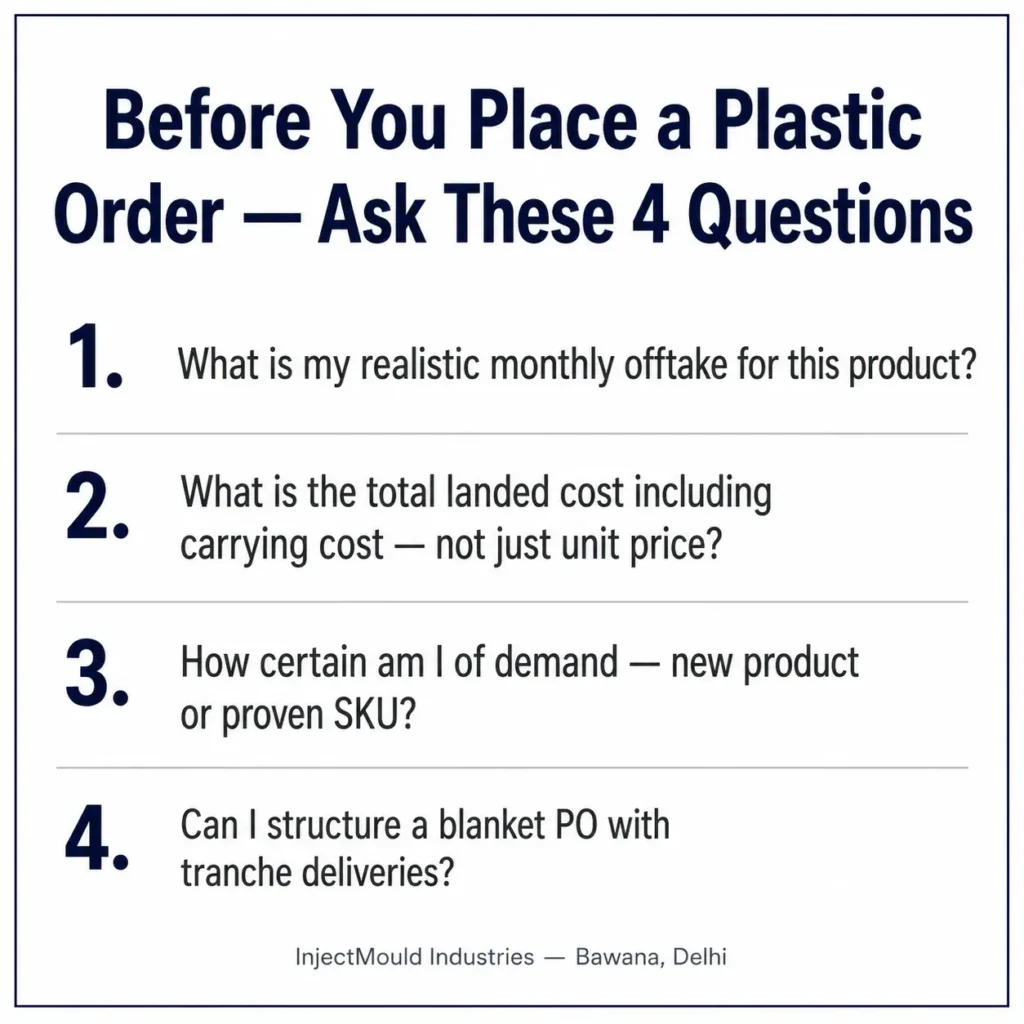
Before your next order conversation, run through these four questions:
- What is my realistic monthly offtake for this product? Multiply by 2-3 months for your target order quantity.
- What is the total landed cost at different quantity tiers — including carrying cost, not just unit price?
- What is my demand visibility? Is this a new product or a proven one with a stable client base?
- Can I structure a blanket PO with tranche deliveries to get volume pricing without full upfront inventory?
Running this exercise before you sit down with a manufacturer puts you in a fundamentally stronger negotiating position. You’re no longer reacting to their MOQ — you’re proposing a structure that works for your business.
The Bottom Line
MOQ and cost per part are two sides of the same equation — and neither one tells the full story on its own. The smartest plastic traders don’t chase the lowest unit price or the lowest MOQ in isolation. They find the quantity structure that optimises total economics: unit cost, inventory risk, cash flow, and demand confidence all considered together.
The good news is that this is a negotiable conversation with the right manufacturing partner. A manufacturer who understands your business — not just your order size — will help you structure orders that work for both sides.
If you’re based in North India and want to have that conversation with an end-to-end plastic manufacturer who works with traders at every scale, InjectMould Industries in Bawana, Delhi is a good starting point. Reach out at +91 9871398314 or amandeep@injectmould.in.
— End of Article —
Recommended For You!
Quick Links
- +91 98713 98314
- Home
- About Us
- Contact Us
- Services
Connect With Us
- +91 98713 98314
- amandeep@injectmould.in
- @injectmould.in
About Us
InjectMould Industries is an end-to-end manufacturing partner for OEMs, delivering reliable custom plastic parts and plastic component manufacturing. Located in Bawana , Delhi.
As experienced plastic component manufacturers, we specialize in injection moulding, tool and die making, and plastic die maker services.
We also offer ABS plastic electroplating for high-quality finishes on functional and aesthetic parts.
Our structured processes support consistent quality and long-term OEM production needs.
injection moulding services
Plastic parts manufacturer bawana