

Import vs. Manufacture Locally: A Real Cost Comparison for Plastic Goods in India
Published by InjectMould Industries, Bawana, Delhi • Reading time: ~7 minutes
Most plastic traders compare the wrong numbers. They look at a Chinese ex-factory quote, see ₹8 per unit, look at a local quote, see ₹14 per unit, and call it decided. But that comparison ignores freight, customs duty, rejection losses, and six weeks of working capital locked in a container somewhere in the Indian Ocean.
In 2026, the true landed cost of importing plastic goods is consistently higher than most buyers calculate — and the true cost of local manufacturing is consistently lower than the ex-factory comparison suggests. This article puts the real numbers on the table, side by side, so you can make the comparison properly.
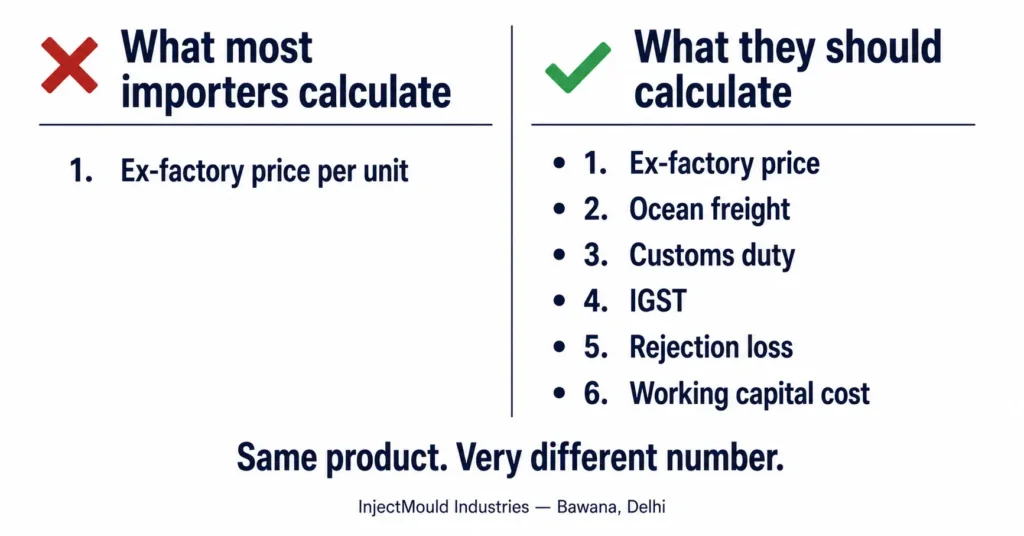
What Importers Actually Pay — The Full Cost Stack
When a trader buys plastic goods from China, the journey from factory gate to their warehouse in India involves costs at every stage. Most buyers are aware of the obvious ones — freight and customs duty. The less obvious ones are where the real money leaks.
The Visible Costs
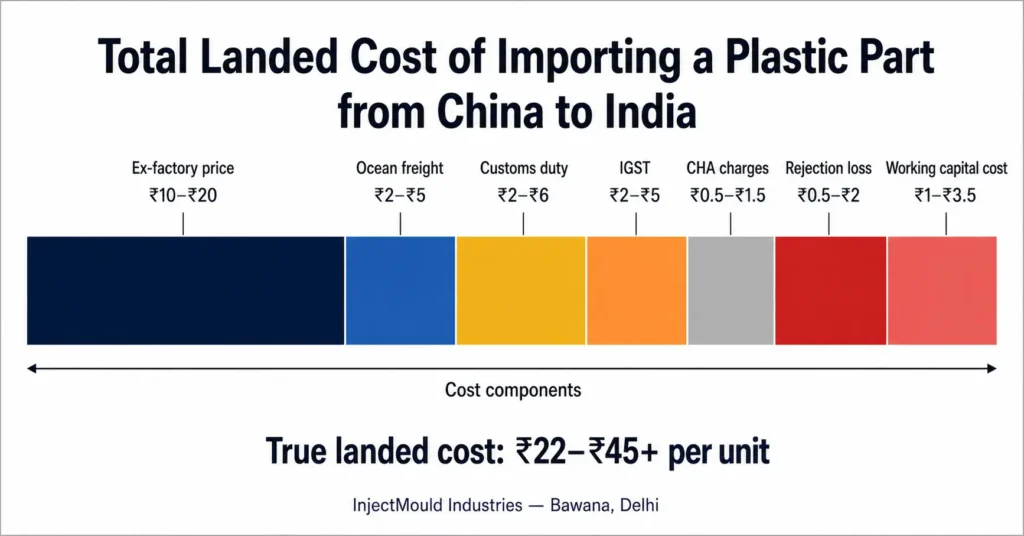
- Ex-factory price: The quoted unit price from the Chinese manufacturer — typically the lowest number in the chain.
- Ocean freight: Container shipping from Chinese ports to JNPT (Mumbai) or Mundra currently runs at approximately ₹18–₹35 per kg for general cargo, depending on commodity and season.
- Basic Customs Duty (BCD): Plastic goods attract 7.5%–15% BCD depending on HS code classification. This is applied to CIF value — cost plus insurance plus freight.
- IGST on import: 18% IGST is levied on the assessable value (CIF + BCD). While this is recoverable as Input Tax Credit for registered businesses, it ties up working capital until the credit is utilised.
- Port handling and CHA charges: Clearing agents, port handling, and documentation typically add ₹3,000–₹8,000 per consignment, spread across units.
The Hidden Costs
- Quality rejection and rework: Industry estimates for import-sourced plastic goods put rejection rates at 3%–8% of order value. Remote quality control, communication gaps, and distance make correction expensive and slow.
- Working capital cost: A 45-day supply chain (30 days shipping plus 15 days production lead time) means your capital is locked up for 6–8 weeks before you can sell a single unit. At 12% annual financing cost, a ₹10 lakh shipment costs ₹15,000–₹20,000 in interest alone.
- Minimum order premiums: Chinese manufacturers often require large minimum orders to justify export pricing — locking traders into inventory risk they may not be able to absorb.
- Currency risk: INR-USD fluctuation can add or subtract 2%–5% from your effective cost between order placement and payment.
What Local Manufacturing in India Actually Costs
The common perception is that Indian manufacturing is more expensive at the unit level than Chinese imports. This is partially true for the ex-factory comparison — and completely misleading as a total cost comparison.
Here is what local plastic manufacturing in India actually involves cost-wise:
Tooling — One-Time, Amortised Over Production Life
If you’re sourcing a custom part, tooling cost exists whether you manufacture locally or import. Indian tooling costs are typically 20%–40% lower than equivalent Chinese tooling for comparable complexity — a significant advantage if you’re setting up a new product.
Per-Unit Production Cost
For injection moulded plastic parts manufactured in India — factoring in material, machine time, labour, and overheads — typical per-unit costs range from ₹9 to ₹18 for standard parts at moderate volumes. This is higher than Chinese ex-factory quotes for the same parts, which might come in at ₹6–₹12.
But this is where the comparison typically ends. It shouldn’t.
What You Don’t Pay Locally
- Zero ocean freight — domestic logistics in India run at ₹2–₹8 per kg by road, a fraction of international freight
- Zero basic customs duty
- GST instead of IGST — and for B2B buyers, this is fully claimable as ITC with no working capital lock-up beyond the standard credit cycle
- No currency risk on manufacturing cost
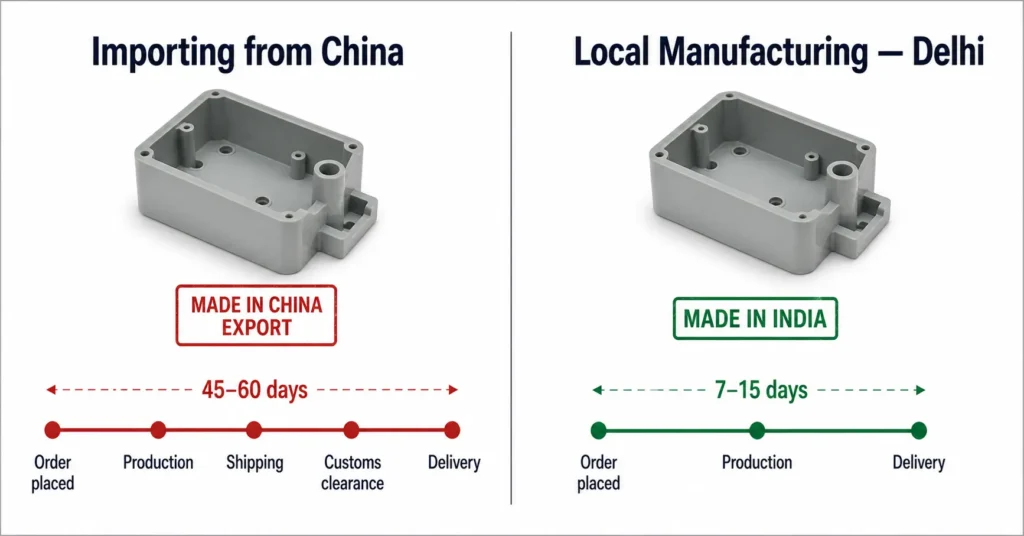
- 7–15 day lead times instead of 45–60 days — dramatically reducing working capital tied up in the supply chain
The Real Cost Comparison — Rupees on the Table
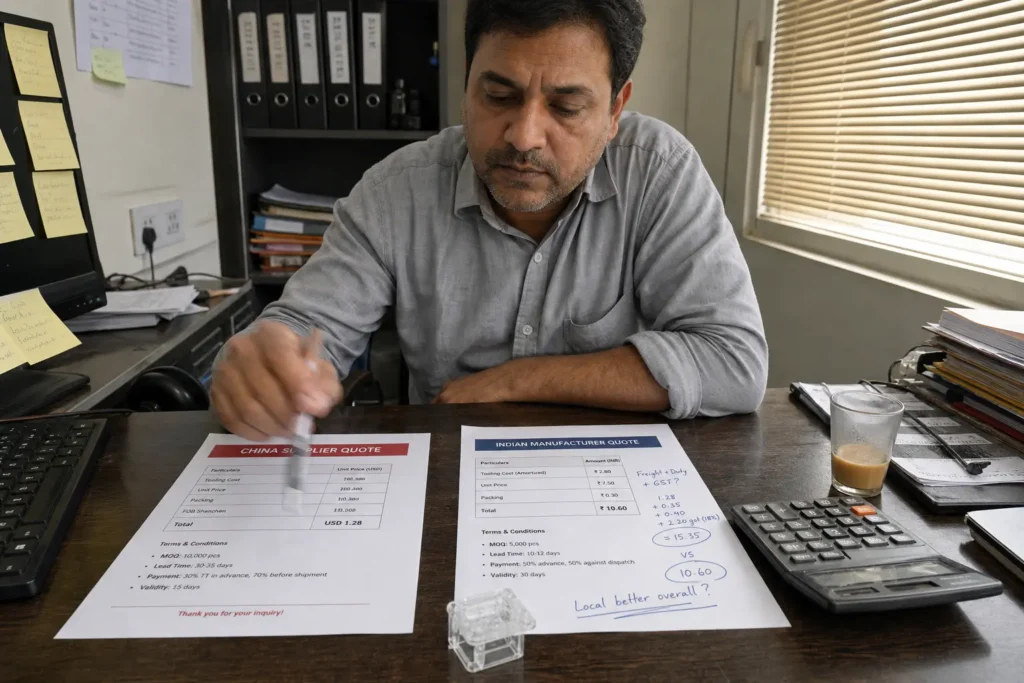
Here is a direct cost comparison for a moderately complex injection moulded plastic part, ordered at 10,000 units, in 2026 Indian market conditions:
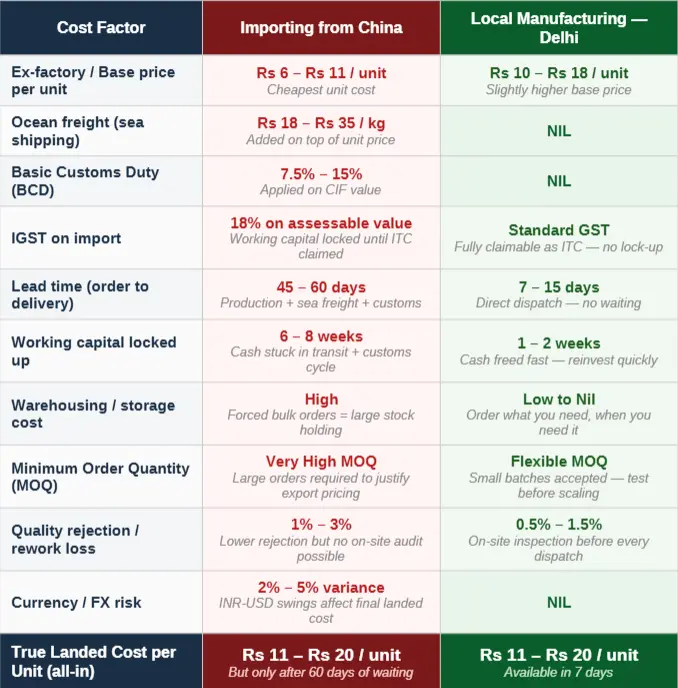
The numbers in this table are estimates based on current market conditions. Your actual figures will vary by product, supplier, and logistics route. But the structure — the pattern of where costs accumulate — holds across most plastic product categories.
The conclusion is not that importing is always wrong. It’s that the true landed cost of importing is consistently underestimated, and the true cost of local manufacturing is consistently overstated — because most comparisons stop at the ex-factory price.
When Importing Still Makes Sense
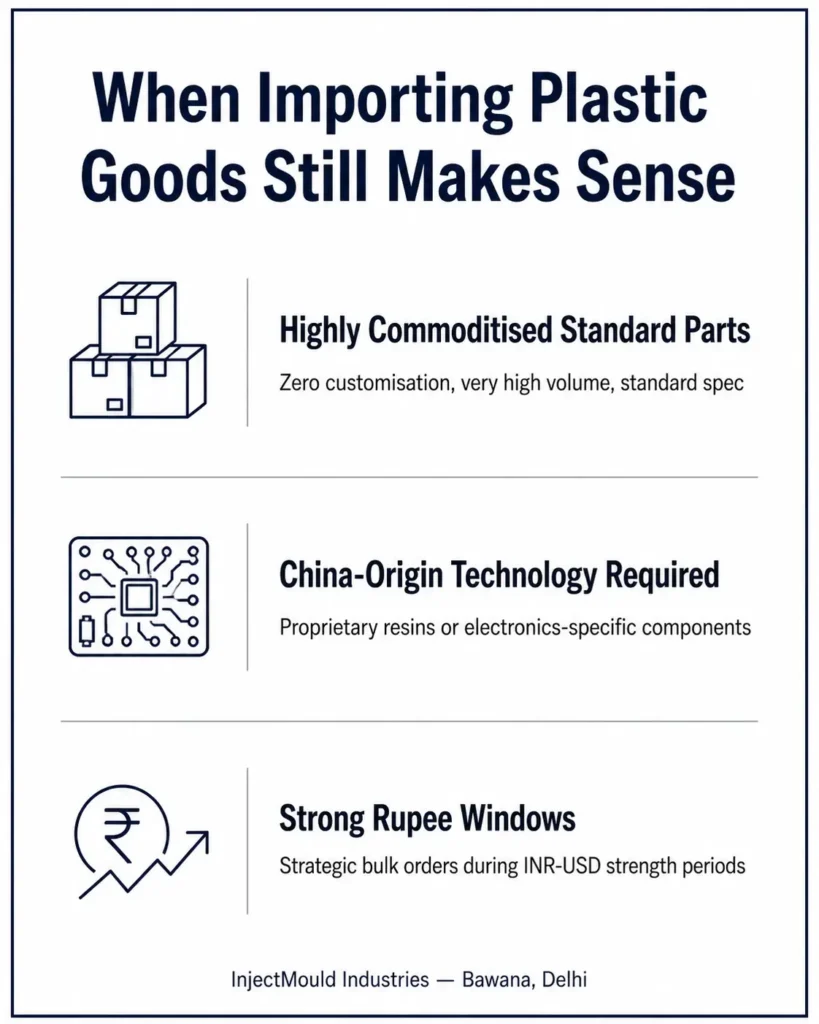
An honest comparison has to acknowledge the cases where importing genuinely wins. There are three:
1. Highly Commoditised, High-Volume Standard Parts
For completely standardised plastic commodities — basic PP containers, standard HDPE jerry cans, generic pipe fittings — Chinese production at scale still achieves unit economics that Indian manufacturing struggles to match. If your product has zero customisation requirement and your volume is very high, import may still be the right call.
2. Products Requiring Specific Chinese-Origin Technology
Some plastic products — particularly in electronics, specialised automotive components, or items using proprietary Chinese resin formulations — have genuine supply chain reasons to source from China. This is a technical constraint, not just a price one.
3. Short-Term Arbitrage During INR Strength Periods
When the rupee strengthens against the dollar, import costs temporarily become more attractive. Some traders strategically time large import orders during these windows — a legitimate but high-risk strategy given currency volatility.
For the vast majority of plastic goods categories — consumer goods, FMCG packaging, industrial components, OEM parts, speaker components — the honest comparison puts local manufacturing in India at or below the true landed cost of importing in 2026.
How to Run This Comparison for Your Own Product
Before your next sourcing decision, run through this framework:
- Get a local quote — not just an import quote. Most traders only shop one side of the comparison.
- Add freight, duty, and IGST to your import quote. Calculate on CIF value, not ex-factory.
- Estimate your rejection rate honestly. If you’ve imported before, what percentage did you write off?
- Calculate working capital cost. Take your order value, multiply by your financing rate, prorate for the lead time difference between import and local.
- Compare total landed cost — not ex-factory price.
InjectMould Industries works with traders at exactly this stage of the decision — providing transparent, itemised quotes for plastic manufacturing in Delhi so you can run a genuine comparison rather than an incomplete one. The conversation is worth having before you place your next import order.
The Bottom Line
The import vs. local manufacturing debate for plastic goods in India is no longer as one-sided as it once appeared. When you account for freight, customs duty, rejection losses, working capital cost, and lead time risk, local manufacturing in India is cost-competitive — and in many product categories, the cheaper option outright.
The traders who are discovering this aren’t making a patriotic choice. They’re making a financial one, based on a complete cost comparison rather than a surface-level price comparison.
If you want to run the numbers for your specific product, InjectMould Industries in Bawana, Delhi offers end-to-end plastic manufacturing with full cost transparency. Reach out at +91 9871398314 or amandeep@injectmould.in to start the conversation.
— End of Article —
Recommended For You!
Quick Links
- +91 98713 98314
- Home
- About Us
- Contact Us
- Services
Connect With Us
- +91 98713 98314
- amandeep@injectmould.in
- @injectmould.in
About Us
InjectMould Industries is an end-to-end manufacturing partner for OEMs, delivering reliable custom plastic parts and plastic component manufacturing. Located in Bawana , Delhi.
As experienced plastic component manufacturers, we specialize in injection moulding, tool and die making, and plastic die maker services.We also offer ABS plastic electroplating
for high-quality finishes on functional and aesthetic parts.
injection moulding services
Plastic parts manufacturer bawana