Injection Moulding Services in Delhi: Process, Capabilities and Pricing Factors
Published by InjectMould Industries, Bawana, Delhi • Reading time: ~7 minutes
If you have searched for injection moulding services in Delhi lately, you have probably noticed that most manufacturer websites say almost the same thing. Quality parts, latest machines, competitive pricing, done. None of it tells you what actually happens on the shop floor, what a manufacturer can realistically produce, or why one quote comes in at eleven rupees a piece while another comes in at nineteen for what looks like the same part.
This piece walks through all three of those questions in plain language. First, what the injection moulding process actually looks like from drawing to finished part. Second, the capabilities that separate a serious manufacturer from a small setup running one machine. And third, the factors that genuinely move your price up or down, so the next quote you receive makes sense instead of feeling like a guess.
Most buyers judge a moulding company by its website. The ones actually worth working with can be judged by three things instead: how they run the process, what they can genuinely produce, and how transparently they price it.
What Actually Happens Inside an Injection Moulding Unit
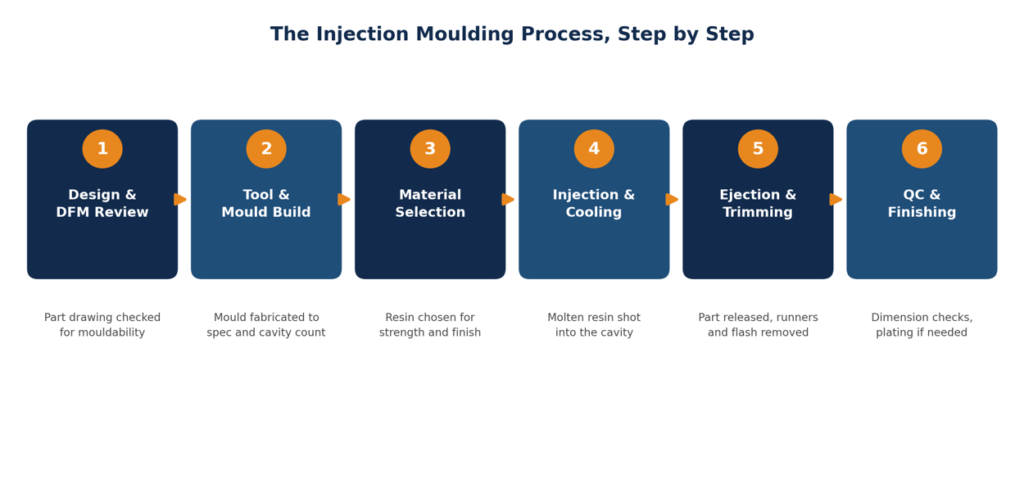
Injection moulding sounds complicated from the outside, and in some ways it is. Broken down, though, it is six stages, one after another, each one shaping how the next turns out.
- Design and DFM review. Before any steel is cut, your part drawing is checked for mould friendly design. Wall thickness, draft angle, rib placement, all of it gets reviewed here. A manufacturer worth working with flags problems at this stage, not after the tool has already been built and paid for.
- Mould and tool build. The mould is a precision steel tool, and it is usually the single largest cost in the whole project. Build time in Delhi typically runs three to six weeks, depending on part complexity and how many cavities the tool needs.
- Material selection. The resin is picked based on what the part actually has to do. ABS for a tough plastic housing, PP for something flexible and chemical resistant, nylon or POM for gears and load bearing components that take repeated stress.
- Injection and cooling. Plastic pellets are melted and shot into the mould cavity under high pressure, then held while the part cools and takes its final shape. This is the stage where cycle time, and therefore your cost per part, gets decided.
- Ejection and trimming. The finished part is ejected from the tool, and the runners, which is the plastic left behind in the feed channels, are trimmed off. Good manufacturers regrind and reuse this material rather than wasting it.
- Quality check and finishing. Dimensions are measured against the original drawing, and if the part needs plating, printing, or assembly, that work happens here, before the order gets packed and shipped out.
What Capabilities Actually Matter When Choosing a Manufacturer in Delhi
Delhi and the wider NCR belt have no shortage of injection moulding units. What separates a manufacturer worth partnering with from a shed with one machine in it comes down to a handful of capabilities that are worth checking before you place an order.
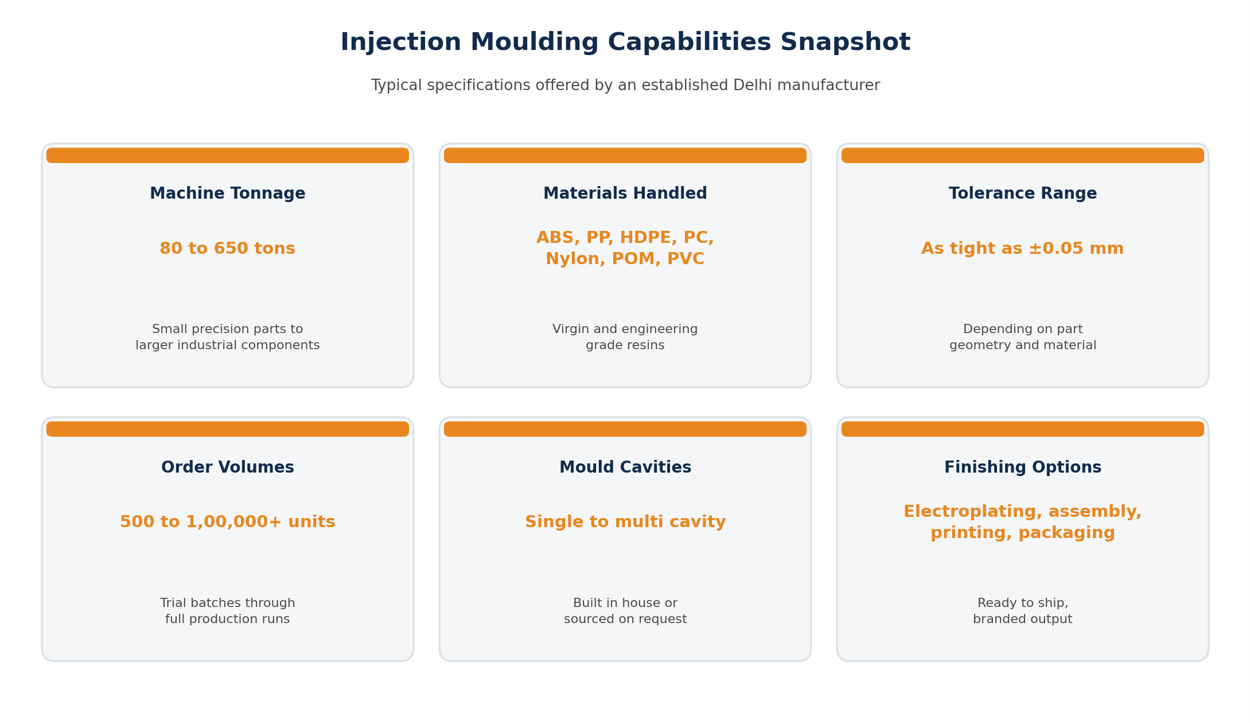
- Machine tonnage range. A broad range, typically 80 to 650 tons, covers everything from small precision components to larger industrial parts, without needing to outsource half your order to a different vendor.
- Material experience. Real, hands on experience across ABS, PP, HDPE, PC, nylon, POM, and PVC, not just familiarity with one resin the operator happens to know well.
- Tolerance and repeatability. The ability to hold tight tolerances, as close as plus or minus 0.05 millimetres on suitable parts, consistently across a full production run, not only on the first sample piece.
- Tooling under one roof. Mould design and fabrication handled in house, so a design change does not turn into a weeks long back and forth between two separate vendors.
- Volume flexibility. Comfortable running a five hundred unit trial batch and a hundred thousand unit production order alike, without treating either one as an inconvenience.
- Secondary services. Electroplating, assembly, printing, and packaging available in house or through a closely managed partner, so what reaches you is a finished, ready to use product, not just a raw moulded part.
What Actually Drives Injection Moulding Pricing
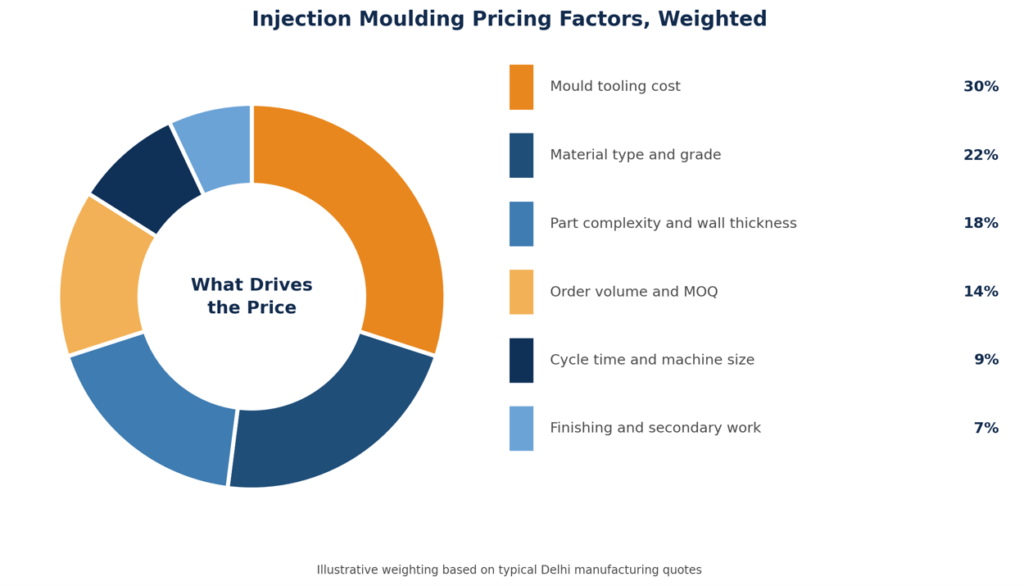
This is the part most quotes never explain. A per unit price on its own does not tell you much unless you understand what is pushing it up or pulling it down. Here is what genuinely moves the number.
- Mould tooling cost. Usually the single biggest line item and a one time cost, spread across the life of the tool. It depends on cavity count, steel grade, and how complex the part geometry is.
- Material type and grade. Engineering grade resins such as nylon, POM, and polycarbonate cost noticeably more per kilogram than commodity resins like PP or HDPE, and they also affect how long each part takes to mould.
- Part complexity and wall thickness. Thin, uniform walls mould faster and cost less. Undercuts, tight ribs, and intricate geometry add both to tooling cost and to the time each shot takes.
- Order volume and MOQ. Cost per unit drops as volume rises, because the one time tooling cost gets spread across more pieces. Small trial batches will always carry a higher per unit price, and that is expected, not a red flag.
- Cycle time and machine size. A larger machine running a longer cycle costs more per shot. Efficient part design and a well built tool bring cycle time down, which brings your price down with it.
- Finishing and secondary work. Plating, printing, assembly, and packaging each add a cost line, but they also add finished value, since you receive a product ready to sell rather than a part that still needs work.
How to Get an Accurate Quote, Not a Rough Guess
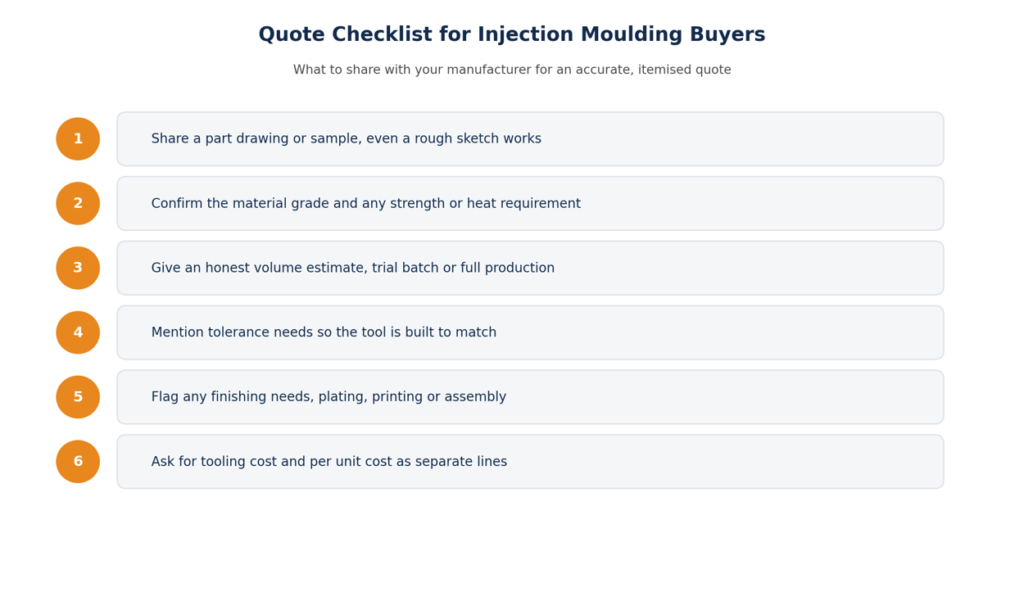
Most quoting delays and surprises later on come from missing information at the start. Before you approach a manufacturer, it helps to have this ready.
- Share a part drawing or physical sample. Even a rough sketch gives a manufacturer something real to quote against.
- Confirm the material grade you need, along with any strength, flexibility, or heat resistance requirement.
- Give an honest volume estimate, whether it is a trial batch or a committed production run.
- Mention your tolerance needs upfront, so the tool is built to match from day one.
- Flag any finishing requirements, plating, printing, or assembly, so they are priced in rather than added on later.
- Ask for tooling cost and per unit cost as two separate lines, so you can see exactly where your money is going.
Where InjectMould Industries Fits In
InjectMould Industries works out of Bawana, Delhi, running the complete process described above under one roof, design review, in house tooling, injection moulding across a wide tonnage range, and finishing services including electroplating and assembly. Every quote is itemised, so you see the tooling cost and the per unit cost separately, not folded into one number you cannot question.
If you have a part in mind, reach out at +91 98713 98314 or amandeep@injectmould.in and we will walk through what it takes to produce it properly.
The Bottom Line
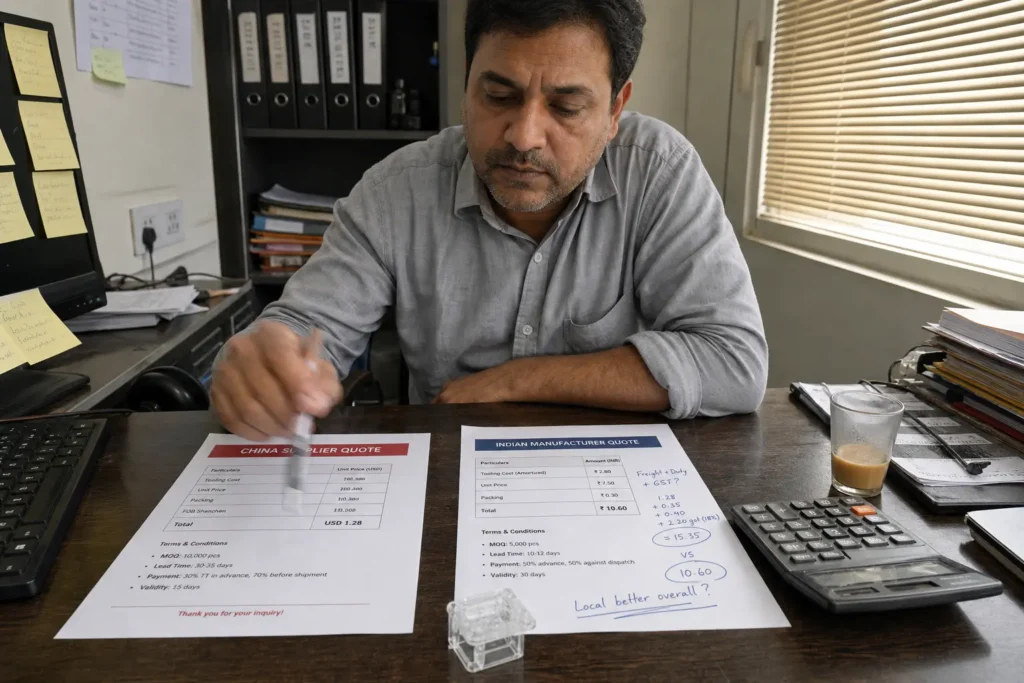
Injection moulding services in Delhi vary enormously in quality, and the difference rarely shows up in a website or a brochure. It shows up in whether the manufacturer reviews your design before quoting, whether they can genuinely handle your material and volume, and whether their pricing is broken down honestly enough for you to understand it.
A manufacturer that walks you through the process, states its capabilities plainly, and explains its pricing without hiding behind a single flat number is usually the one worth working with long term. That is a fairly simple test, and it filters out most of the noise in this market.
Recommended For You!
Quick Links
- +91 98713 98314
- Home
- About Us
- Contact Us
- Services
Connect With Us
- +91 98713 98314
- amandeep@injectmould.in
- @injectmould.in
About Us
InjectMould Industries is an end-to-end manufacturing partner for OEMs, delivering reliable custom plastic parts and plastic component manufacturing. Located in Bawana , Delhi.
As experienced plastic component manufacturers, we specialize in injection moulding, tool and die making, and plastic die maker services.We also offer ABS plastic electroplating
for high-quality finishes on functional and aesthetic parts.
injection moulding services
Plastic parts manufacturer bawana